Sunday, 31 January 2010

Eek - they found me!

Dear all,

Cataclysmic times are apon us! My peace and quiet has been shattered! There I was, thinking it was just mice running around in the pipes (or perhaps my pet rocks - they've been escaping again lately, the clever little things), and suddenly they come crashing through the wall! Worse still, the whole thing was caught on security cameras, and now they're putting it up on YouTube! Can you believe the impudence?

I don't mind telling you, it was quite a shock. For them, I mean. I like to think that they were all over-awed by the sheer splendour of the gallery before them... but that's doesn't quite explain the expressions of horror, so perhaps that's not it.


Anyhow, over the past week, they've been taping over the edges, sticking things over the shelves to keep my hands off, and making all sorts of ridiculous pictures of me. Some of them were even videos, which was quite fun - perhaps I should become a film star instead? I bet I could set box office records... but perhaps not the ones they're hoping for.

After all the excitement, the good news is that they're letting you all in to see the place. At least, I think it's good news. I really wasn't ready yet - a few more months of experiments, and perhaps there would have been all sorts of wonders... but still, I do have lots to show you. We'll have to see how the crystal gardens develop, and I'll need help with my cave painting project. Believe it or not, it's free as well, so you can come back as often as you like. I suppose they thought it wouldn't really be fair to charge entry for something like this... although if we get lots of donations, then I might be able to add extra experiments - and you'd like that, wouldn't you? You can make suggestions on the feedback forms as well - I promise I'll read them, and if it's a good idea I might even try it.


You may well see me running in and out of the gallery to check on things, so please feel free to say hello if you do. Actually, if you could remind me about fixing my rock cage, that would be really helpful. And please do keep an eye out for escapees - I know there are loads of them scuttling around the exhibition, and I fear that some of them are getting even further afield.
Two lucky victims - sorry, recipients - of Dr. Sock's hat-making. At least one of them seems happy...

Enough for now. I'm off to recover from the experience of meeting the press. Abnormal service will be resumed shortly. Please come visit me at the Leeds City Museum, and let me know of any requests for strange subjects that I can write about (yes, I'm working on the dissolution one, anonymous!)


Toodle-pip.

Tuesday, 12 January 2010

In the bleak mid-winter...

Hello all,
There's one type of crystal that's been at the forefront of everyone's mind over recent weeks - at least in the UK. I am, of course, talking about the glorious hexdendritic dihydrogen monoxide. Crystals are normally things you have to go out looking for to find, but not at the moment. You could hardly avoid them, whizzing over your head in powdery ballistic spheroids, or joining forces in a bold attempt to stop the trains going anywhere.
Of course, I'm talking about that delightful thing called snow. When you see satellite photographs showing the entire country covered by a white blanket, you get a sense of the scale of it. Crystals, crystals, everywhere...
So does ice count as a mineral? It seems like a tricky one, at first. According to the International Mineralogical Association's official definition, a mineral is a solid, chemically homogeneous and normally crystalline substance that formed geologically. Well, ice is certainly solid (when it's not melted, of course), and it's certainly a homogeneous crystal... in fact, ice does fit all the criteria.
It turns out that ice is indeed defined as a mineral by the IMA. It could hardly not be, really. If it melted at a couple of hundred degrees, instead of zero, then you'd never think to question it (it wouldn't rain either, of course, and there wouldn't be any oceans, tea, or indeed living things; so you'd probably have better things to not worry about). Where was I? Oh yes: ice. It even forms familiar types of crystal growth... here are some stalactites, for example:

Ok, so snowflakes are a bit weird, though. It's said that every snowflake is unique, and it's probably true... but the shape still follows simple rules. Like apatite, beryl and wurtzite (I like that one!), ice has hexagonal crystal symmetry. It tends to grow more quickly at the tips of the hexagon, though. Each spine often branches repeatedly, leading to the typical snowflake shape:
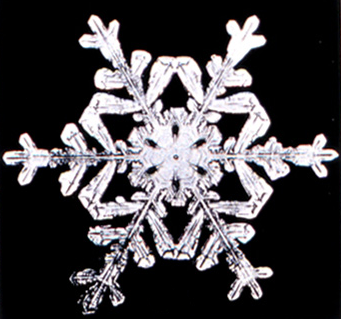
You can see immediately it's not a random branching pattern, because it's the same on each spine. So what controls it, and why is each one unique? It's all down to the conditions it forms in. When atoms join onto the tip of a crystal, the place they attach to depends on the exact humidity and temperature. Under some conditions, the crystals will form almost perfect hexagons (although I've never seen these myself):
If the temperature is quite cold where they form (-3 to -8C), it's common for all except one or two rays of the crystal to not form at all. I was a bit surprised to find little snowy needles falling on me the other day, so I'm very glad to find out what was happening.
The normal pattern that we see is called a dendrite, from the greek word for tree - it branches. (People often think scientific words are really high-brow, but it's really not true; you just need to look at species names, like Horridonia horridus... scientists really do know how to have a bit of fun when they can get it!) Dendrites are common structures in crystals, whenever it grows mostly in one direction, and occasionally branches. Here's some pyrolusite (manganese dioxide) I found earlier.
Anyway, back to ice. It would be much more obvious that we should think of it as a mineral if we had, say, pebbles of ice in our rivers. Well, if you go to Titan, the moon of Saturn, that's exactly what you get - pebbles and boulders of water ice, in ethane or methane rivers. Water can even form the solid surface of some planetary bodies, and I must confess I'd really like to visit some of them...

Take Europa, for example - a fabulous place. The crust is made of water ice, probably with a deep ocean underneath. Where the crust has cracked, more water has frozen in the gaps, and some of this is coloured brown. What does that mean? Probably that there are minerals dissolved in the ocean, and circulating around with it. And where there are minerals and water, there might be life. A pet rock from Europa would really be something... I wonder if I could keep it in my freezer?
Thanks to NASA for putting these pictures in the public domain. I must go and do some more about putting my exhibition in the public domain too, now. I've just got hold of some flint to try my hand at knapping now... which reminds me, I must go and buy some plasters. Toodle-pip!

Wednesday, 6 January 2010

Dear Readers,
It's been a busy week! I've been working on my captions (how many bad puns do you think I can get into one exhibition?), and even got our conservator in Leeds to clean up some wonderful Burmantofts pots, without needing too much of a reason. The dragon one is gorgeous. Somehow, I've even persuaded the Temple Newsam curator to lend me a magnificent Chinese jade sculpture - had to be careful not to let on what I was up to, though. I'm getting worried that some of them might be on to me, though. It's the vanishing for weeks on end that's making them suspicious, I reckon. Must work faster, just in case!
Well, what became of the sheep, I hear you ask? I must confess that the vets are not optimistic the poor thing will survive the winter. It appears to have been cruelly treated by callous owners more used to the lucrative sheep showing circuit; worse still, they must have been entering it into the "poodle-sheep" category. Sadly, it wouldn't even have won - I fear that the hairdresser had been at some of my concoctions, and the result is... well, disappointing. Dr. Sock, I hasten to add, is entirely blameless in this case. She told me so, so I suppose I'd better believe her.
Moving swiftly on, I promised an update on the green gloop, and that at least is living up to its billing! Indeed, it's turning more gloopy by the minute, and a delightful brown sludge has appeared at the bottom of the cup. There are definite flakes of copper in it, but beyond that I'm baffled. For a few hours, some more mirabilite crystals appeared on the string, but they took a quick look around and decided that they needed to be somewhere else... I really am intrigued by what is going to happen next!

Soup, anyone?

The string itself is going a bit strange. Normally, string hangs down vertically, like the one in the copper sulphate +boric acid + what used to be aluminium (more of that in a mo) mixture. The one on the right has been in the green gloop, and has opted for a different strategy. It seems to be turning into a copper wire, and I fear it may have plans to plug itself into the mains before taking over the world. Honestly, it was muttering to itself the other day. Or perhaps that was just me.

Ah yes, the copper. Remember that bit of aluminium I was dunking at the beginning? I was getting worried by the buildup of hydrogen in the kitchen, so I transferred it over to the boring old copper sulphate + borax experiment. Much to my relief, it became much more relaxed, but the strange brown colouring still carried on growing. Of course, as some of you have no doubt worked out, the brown stuff is metallic copper. Yep, pure copper metal. I could use it to make a kettle, if I was mad enough. But I'd need quite a bit more. Presumably the dissolved aluminium ions are now swimming around in their nice blue sea...
Copper metal that replaced the aluminium foil - really rather neat!
Since you asked so nicely, I'll let you know what's going on in the pther beakers too. Suagr's in one - but it's boring at the moment - nothing going on at all. The salt is much better - nice little crystals growing happily, but they're probably the easiest of the lot. It would be nice to get some big ones, though. The others are just plain copper sulphate (doing very nicely indeed, thank you!), alum (something is finally starting to happen... but very slowly) and borax (lots of stuff, but it's really not thrilling, even when you zoom in really close. I'm sure I'll get some good crystals one day, though.
Boring old copper sulphate. It is blue, though.
Salt. Nice, eh?
Oh yes, and the mirabilite - it's been drying out well, and is now rather lurid green crust. This should, with any luck, be thenardite - and therefore fluorescent! We'll know soon enough, I promise...


That'll do for now - lots to do still, and there's something else I want to tell you about soon as well!

Thursday, 31 December 2009

Ho Ho Ho!

Dear readers one and all,

A Merry Christmas (slightly delayed, but what's a fwe days to a geologist?) and a pre-emptive jolly New Year as well. It should be quite a year, too... it's possible that I'll finish my gallery, and can finally present it to the world (well, Leeds anyway).

The currently bald sheep. Poor thing.

In the spirit of general festivity, what better things to give to one's dear ones than some sparkly things? Diamonds, I hear you ask? Rubies and sapphires? No, don't go giving her ideas. A woolly sheep will do for starters. For, you see, my dear Dr. Sock is a dab hand with the old knitting needles, and has been threatening to get a sheep for ages. In an attempt to forestall this, I've got her one first, and yes the wool really does grow. Although the poor thing is a touch on the chilly side at the moment... I'll let you know how the fleece grows, and how she gets on with the knitting with it.


For my dad, what better way to get him to take out the geological hammer than with geodes? These wonderful little things are sufficient to assuage anyone's gambling urges, and at the same time... well, they're rocks. Can't say fairer than that.

You see, you can never be sure what's inside a geode until you look. We know how they form, but it's all a bit of pot luck as to whether you have a good one. It all starts with bubbles in lava. Volcanoes erupt because of bubbles - it's the air pockets that makes the magma light enough to rise up to the surface. Once it gets there, the poor lava finds that it should have brought an extra woolly jumper, and promptly freezes - trapping bubbles in mid-escape.

Over the years (and lots of them), water filters through cracks, gets heated by the volcano, and deep underground, strange things begin to happen. First, bits of the solid lava start to dissolve (especially the quartz). Some time later, when the water cools down in the crack and the bubbles, it starts to de-dissolve... and hey presto, a geode! All ready for the smashing.


What you find when you crack them open are normally layers of crystals (often coloured quartz) growing in from the edges. Sometimes the crystals are too small to see, and you just have coloured bands of chalcedony (agate) instead. The best ones are hollow in the centre, so you can see the crystal shapes pointing inwards, but quite often they're solid. The colours are due to other things dissolved in the water, which formed impurities in the growing crystals - iron, magnesium, uranium, kryptonite...


So how did he do? Well... it could have been worse. The first two were virtually solid, but you can at least see layers of blue-grey chalcedony, surrounded by less pure brown stuff. It looks like the second geode has been cracked while forming, with the clearer bit in the middle forming later. The third one was better - almost clear blue-grey chalcedony with a hollow centre coated in tiny quartz crystals. Not bad for a beginner.
Of course, to get the more interesting crystals is more of a challenge. Quartz is all very well, and it's vital for our technology (that's where silicon comes from) - but the stuff in these geodes just isn't pure enough to be useful. The only reason for collecting these geodes is because they look pretty. There's nothing wrong with that, of course - it's how most people start getting interested in minerals. On the other hand, it's not going to solve all humanity's problems. You need lots of different minerals to do that...

Wednesday, 23 December 2009

Sal Mirabilis!

Mornin' all.
For those who can't sleep for worrying about what's going to turn up in the green gloop, here's a quick note to let you know. After the first day, long clear needles started appearing on the string - up to 2 cm long. As soon as I got the camera out, though, they'd all vanished!

This does happen, sometimes - things crystallise, and then dissolve again. This time, though, it was more mundane - the crystals had got too big and fallen off!

So, a quick decant later, and here they are, growing together in the bottom of the beaker:

The green is just colouring from the solution itself, and don't worry about the brown blob on the right - that's the remains of a paperclip I dropped in for fun. As I might have said, it's good stuff, this!

Now, I know you're dying to know what this is, so here you go:

The crystals have a parallelogram-shaped end that slopes to one side, but are otherwise long thin prisms. Of the possibilities from what went into the gunk (sodium chloride, copper sulphate, and a bit of aluminium) this can only be...


Mirabilite!
(hydrated sodium sulphate, Na2SO4.10H2O)

Nice name for a very nice little crystal. Now, since we've taken some sodium and sulphate ions out, there should be a bit of copper chloride waiting for us after Christmas... that'll be fun! Unfortunately it's doomed to crumble into a white powder once it loses water. But it does make an exceedingly good purgative, as discovered by Glauber in 1645... and hence the name! Miraculous indeed! Any volunteers?
Have a lovely sparkly holiday, and may Santa bring you lots of obscure mineral growths that you've never seen before. If he doesn't, I suggest checking his beard for them. That's where I keep mine.


Tuesday, 22 December 2009

Latest experiments!

Dear Reader,

I never get tired of growing my own crystals. Many of you will have grown crystal gardens in your childhood days, perhaps from salt or copper sulphate. You can buy kits, of course, to help with this, but a lot of them cheat by making chemical reactions happen in front of your eyes. Those ones really don't tell us much about natural minerals...

No, the best methods are those that let the crystals grow naturally, as they want to. We merely... encourage them. Perhaps with an oven, if we need to. Actually, I must confess to getting bored as well, so I'll speed them up when I can. I don't think it makes much difference to the result, though - it all comes out in the wash (unless you're using potassium cyanoferrate - that stains like anything!).

I should probably explain how to do it, too. Take lots of whatever you want to grow, dissolve it in water, and let it evaporate. That's about it, really.

So, guess what? I've got hold of some boric acid, copper sulphate, and aluminium sulphate. They're all nice crystals, if a little toxic. I make very sure not to get them mixed up with my muesli, I can tell you. As long as you don't eat/drink/inhale/spill them, they're pretty harmless. Copper sulphate gives you a gorgeous blue colour when you dissolve it in water, too. Here's some I've started to make at home.

Now, I read somewhere recently that if you dissolve copper sulphate and salt (sodium chloride)together, you get a really nasty liquid that's used to etch metal. I've not heard what crystals you get when it evaporates, though. Of course, it's far too dangerous to do this at the museum - they wouldn't like that at all. So I've done it in my kitchen instead. :)

For some reason it turns a wonderful dark green colour. That's always a bad sign - I mean, would you drink something that looks like that? Then, of course, I had to test the alleged metal-etching powers of the mixture... does it live up to expectations..?

Here's what happens when you dunk a bit of scrunched-up aluminium foil in it. Note the fizzing. I'm not sure what gas was coming off, but it was probably chlorine or hydrogen, so I'm not going to get too close...


On the right is the aluminium after 20 seconds of dunking. Good, eh? Any guesses as to which crystals will end up growing in that horrible gloop first? Sodium sulphate? Copper chloride? Just some weird green gloopy stuff?


You'll just have to come back and find out. I honestly haven't the faintest idea. But when I do know, I'll tell you. Along with revealing what's in those other beakers...